Working with suppliers
What to include in your wedding florist brief
Give your florist the pictures, priorities and practical details they need to understand your wedding. Here is what to include, with a sample concept brief and an outline you can use.
What your florist needs
A wedding florist brief should cover your date and locations, the look you love, the pieces and quantities you need, your budget and priorities, and the practical arrangements. Include selected images with notes explaining what matters in each.
1. Start with the shape of the wedding
Put the essentials at the top: your names, wedding date, venue or venues, approximate guest count and the events you are planning. If something is still undecided, say so. Your florist can then see what they are being asked to design for and what still needs a conversation.
For celebrations across several days, list each event separately. Note whether you are looking for flowers for the whole wedding or for a particular part, such as a sangeet, ceremony or reception.
Add the style of the space. Your own venue pictures can help, especially if they show the ceremony position, dining layout and any existing features the flowers need to work around. Keep those separate from your concept images so the setting and the proposed direction are easy to distinguish.
2. Explain what you love about the images
Choose the references that best explain your colour palette, shape and texture. Add a sentence to each one. “We love the way the garlands hang” gives your florist something more specific to discuss than “we like this”.
Describe how much of the image you have in mind. You might love the flowers in a grand ceremony backdrop while wanting a smaller arrangement. Say which part is the priority and invite your florist to suggest how it could work in your venue.
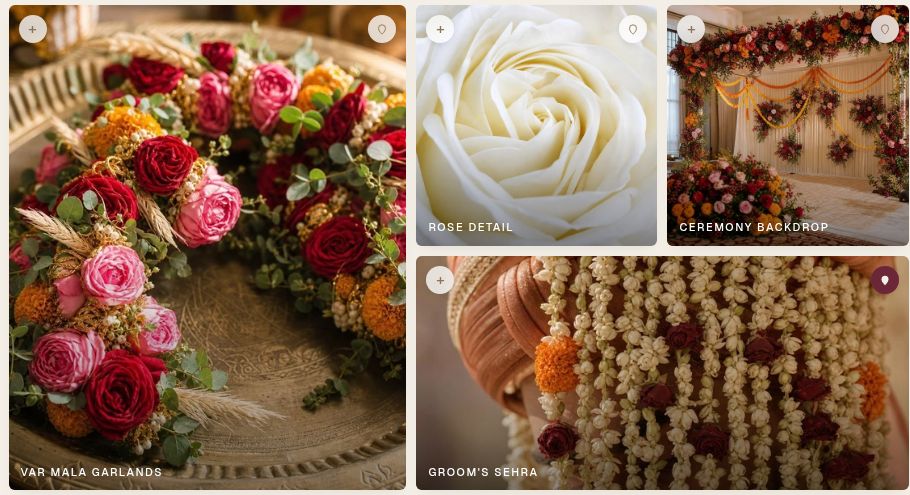
If your ideas are still scattered, start with our wedding mood board guide. A shared visual direction makes it easier to explain what belongs together.
Be clear about flowers and flexibility
List any flowers or colours with personal meaning, anything you dislike, and any scent sensitivities you want to discuss. Ask which choices are realistic for your date and what alternatives could keep the same feeling.
The RHS groups cut-flower choices by season. Use seasonal information as a starting point, then ask your florist about availability and suitability for your own wedding. If using British-grown flowers matters to you, include that preference in the brief.
3. List the pieces, their purpose and quantities
Walk through the celebration in order and write down where you want flowers. Include personal pieces, the ceremony, guest arrival, the meal and any other area that matters to you. Mark uncertain quantities as estimates.
| Area | Details to include |
|---|---|
| Personal flowers | Who needs a bouquet, buttonhole, corsage, garland or other piece; the quantity, purpose and relevant outfit details. |
| Ceremony | The structure or space, flowers required, reference images and any requirements from the person leading the ceremony. |
| Guest arrival | Entrance, welcome table or other arrangements, with their proposed positions. |
| Dining tables | Table count and shapes, approximate dimensions if known, and your preferred arrangement style. |
| Other moments | Any flowers for a cake display, celebration space or another named part of the wedding. |
For dining tables, mention anything else that needs space: sharing dishes, candles, table numbers or favours. Ask your florist how the proposed arrangements will sit alongside them and what guests will see across the table.
Give ceremony pieces their proper context
If you need varmala garlands, flowers for a chuppah, a mandap arrangement or a nikah-stage backdrop, name the item and describe its role in your ceremony. Tell the florist who can confirm the relevant details.
Ask your ceremony lead or venue what is appropriate before deciding on placement, materials or moving pieces between spaces. Include any religious objects that need to remain in place, with clear instructions about who handles them. Your own family’s practice belongs in the conversation.
4. Share the budget and what matters most
Give the amount you want to allocate to florals, or a working range if you are still exploring. Explain what you expect it to cover. Ask the florist to separate flowers, any hired items, delivery, installation and collection in their proposal so you can understand the scope.
Rank your priorities. Perhaps the ceremony flowers are the main statement and you would be happy with simpler table arrangements. Perhaps the pieces you wear or carry matter most. Giving that direction makes it easier to discuss where to focus.
A useful way to phrase it
“The garlands and ceremony backdrop are our priorities. We would like simpler table flowers in the same palette. Please show us what you would recommend within the amount we have set aside.”
Ask for alternatives where a reference is beyond your plans. You might keep its colours, looseness or sense of abundance while changing the scale. Let your florist explain the options before you decide.
5. Include the details beyond the flowers
Share the timings you know and the questions still open. A clear practical brief helps everyone discuss how the design will get into place.
- Access: when suppliers can enter, where they unload, and the right venue contact.
- Setup: when each area needs to be ready, and who is providing any structures or stands.
- The space: whether arrangements will be indoors or outdoors, and what alternative setup you want to discuss if the weather changes.
- Moving flowers: which pieces you hope to use again, the time between events, and who would move them. Ask the florist whether this is practical.
- Afterwards: what happens to the flowers, vessels and hired items, and who handles collection or clearing away.
Ask the venue to confirm any restrictions on installations, fixings and candles. Pass the answer to your florist so they can suggest a suitable approach.
See what the visual part can look like
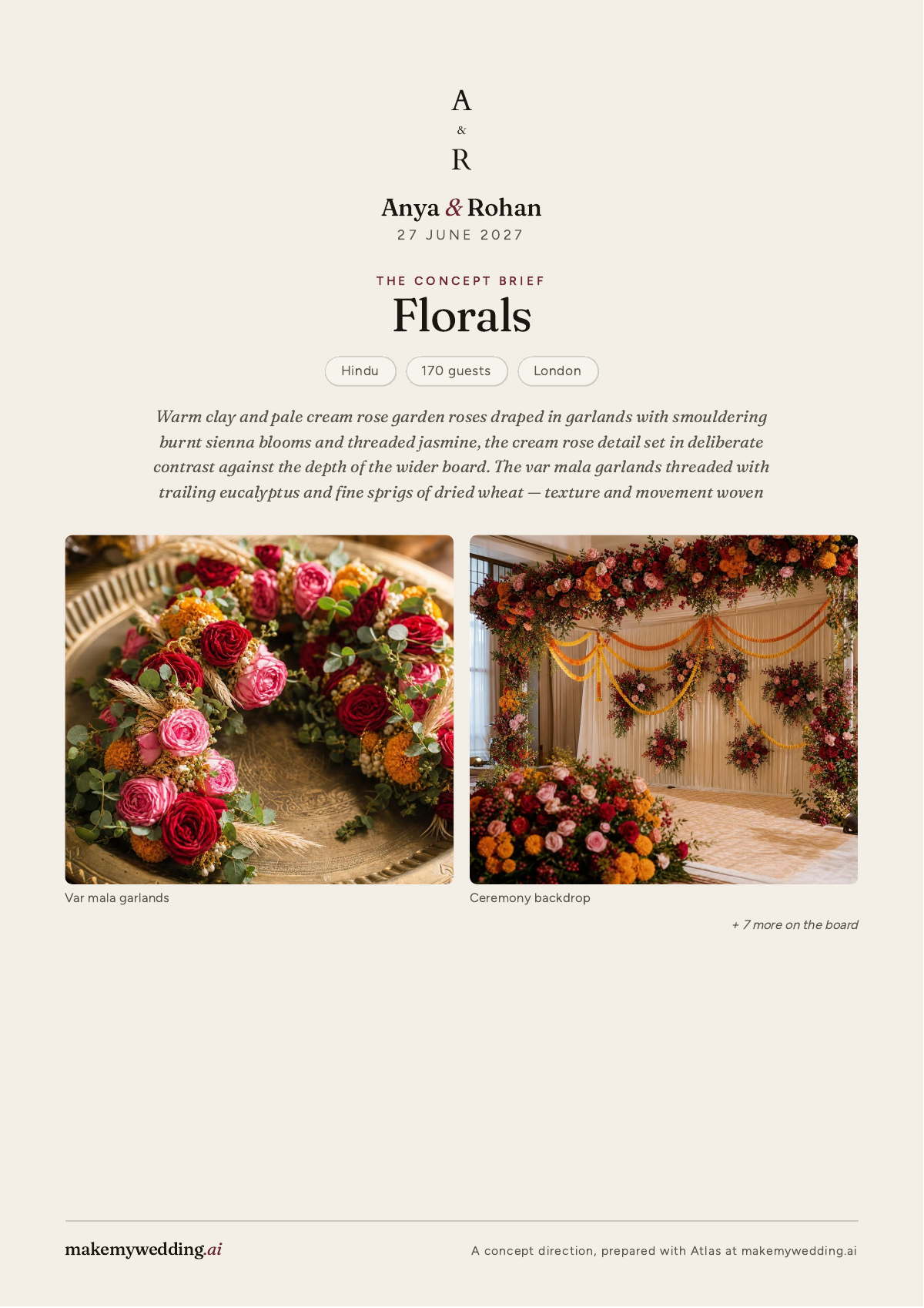
This is the florals concept brief from Anya and Rohan’s demo wedding in makemywedding.ai. The PDF brings together their wedding details, a short visual direction and selected images of garlands and a ceremony backdrop.
A real product export to look through.
Use it to see how a few chosen images can communicate a floral direction.
Download the sample PDF ↓Demo wedding · PDF · One page · 674 KB
In makemywedding.ai, pins become a PDF brief per board. Send the florals brief to your florist, then add the quantities, priorities and practical notes from this guide in your accompanying message. Your florist’s proposal can set out how they would interpret the direction.
An outline you can use
Copy this into your own document or email and replace the prompts with your details. It is fine to write “to be confirmed” where you still need advice.
Your wedding florist brief
Subject: Wedding flowers enquiry, [your date] at [your venue]
Hello [name],
We are planning our wedding and would love to discuss the flowers with you. We have attached a visual brief and included the practical details below.
- Our wedding
- [Your names, date, venue or venues, approximate guest count, and each event you would like flowers for.]
- The feeling and palette
- [How you want it to feel, your main colours, and what you love about each attached image.]
- The pieces we need
- [Each arrangement or personal piece, its purpose, quantity and location. Mark estimates clearly.]
- Ceremony and family details
- [Meaningful items, specific requirements and the person who can confirm them.]
- Our priorities and budget
- [Your working amount or range, what you expect it to include, and where you would most like to focus.]
- Preferences and flexibility
- [Flowers or colours you love, anything to avoid, sourcing preferences and where you welcome alternatives.]
- Practical arrangements
- [Access, setup times, known venue restrictions, any planned moves, and collection or clearing-away questions.]
- What we would like to know
- [Are you available for our date? What would you recommend for this brief? What further information would help you prepare a proposal?]
Thank you,
[Your names and preferred contact details]
One last look before you send it
Check that your images agree with the words, each event has a clear name, and the quantities add up. Make your priorities easy to spot. If there is something you are still deciding, invite the florist’s advice.
Send the same core brief to any florists you are considering, with a personal introduction to each. Keep a dated copy of what you sent. When proposals arrive, look at what each includes, the suggested approach and the questions you still want to discuss.
Seasonal flower reference: RHS, Cut flowers: growing and selection, checked 14 September 2026. Confirm the choices for your date with your florist.